Articles by Aysan Isayo

Follow @aisayo on Github

From AI Opportunity to AI Feature in Rails

At OmbuLabs.ai, we’ve explored the importance of identifying meaningful AI opportunities opens a new window before selecting a solution. Once a worthwhile opportunity has been identified, however, a new question emerges:

Is this problem worth solving in the first place?

Too often, teams focus on the technology before evaluating the value. AI can automate tasks, generate content, and process information at incredible speed, but if the underlying work doesn’t matter, making it faster won’t create meaningful business outcomes.

Once a worthwhile opportunity has been identified, however, a new question emerges:

What should we build first?

Read more opens a new window

How to Parallelize Your RSpec Test Suite

Waiting over an hour for a test suite to finish is a productivity killer.

On a recent project, that was our reality.

Running the full local RSpec suite took almost 2 hours, making it difficult to get quick feedback and confidently iterate on changes. While there are many ways to optimize test performance opens a new window including fixtures, request stubbing, faster tooling, and more, most of these options require significant effort to implement.

Instead, we explored a simpler approach: bringing parallel test execution to local development. The result was a much faster feedback loop (down to 5 minutes) and a significantly better developer experience.

Read more opens a new window

Check If a Gem Is Loaded in Your Bundler

Whether you’re debugging a dependency issue, checking for an optional gem, or just curious about what’s loaded in your Ruby app, there’s a handy command that can help:

puts Gem.loaded_specs.keys.grep(/your_pattern_here/)

In this article, we will discuss what this command does, what exactly it’s checking for, and its limitations.

Read more opens a new window

From Elasticsearch Types to OpenSearch Indices

In earlier versions of Elasticsearch, types were a convenient way to categorically organize documents within a single index. However, types were eventually deprecated, pushing developers toward a type-less structure in Elasticsearch 7 and later versions. Recently while working on a project to migrate a Rails application from Elasticsearch 2 to OpenSearch 2, we faced the challenge of identifying a way to replicate this behavior in a way that is allowed with OpenSearch. In this blog we will discuss how types were used for document organization and how to achieve the same behavior in OpenSearch.

Read more opens a new window

From Code to Compliance: Accessibility Testing

In a previous blog post, How Do You Know When Your App is Not Compliant? opens a new window , I briefly discussed the importance of the accessibility standards of Web Content Accessibility Guidelines or WCAG opens a new window , to ensure that everyone, including those with disabilities, can use web applications effectively. In this blog, we are going to further explore the importance of maintaining accessibility compliance, what it means to users, as well as how to use the axe-core-gems opens a new window for automated accessibility testing to help identify and resolve any gaps that may be currently present in a project.

Read more opens a new window

Managing Long-Running Branches

In software development, there are instances where creating a long-running branch when working on a project will be considered by developers. Long-running branches have been debated a lot by many teams due to their risks mainly around but not limited to, dare I say it, merge conflicts.

However, it isn’t necessarily the evil it’s made out to be and when handled with care, they can present extreme value to a team. Even DHH argues the benefits of maintaining a ‘cohesive architecture’ in this article opens a new window

Read more opens a new window

Is Your Rails App Noncompliant?

Ensuring that your company’s website is current with compliance standards is extremely important and essential for any Rails application. Operating with a compliant application guarantees security that can help with handling sensitive data and maintaining users’ trust. The more compliant your website is, the more secure it will be against data breaches, which helps users feel safe when they’re using it.

So what does it take to be compliant? In this article, we will focus on security and cover some indicators to help identify if your Rails app might not be compliant anymore.

Read more opens a new window

A Step-by-Step Guide to Upgrading Ruby

Every year, Ruby enthusiasts anticipate the December release of a new Ruby version. At the end of 2023, Ruby 3.3 was released and you can read this article opens a new window to learn more about the new features and improvements it brings. This makes it a good time to start considering if your application is due for an upgrade.

Upgrading your application can sound complicated and difficult, but it doesn’t have to be. Below, we will discuss how to identify when to upgrade your Ruby version and the steps necessary to complete a smooth and successful upgrade.

Read more opens a new window

A Comprehensive Guide to Our Roadmap Service

One of our biggest goals as a company is to aim for transparency and honesty when evaluating a project for an upgrade. We understand that the decision to hire an outside vendor versus doing it in house becomes a difficult one. To provide confidence and a clear path to completing an upgrade, before we even begin a project we invest time in doing a thorough investigation of the project to provide the most accurate and detailed game plan for an upgrade.

In this blog, we are going to break down our Roadmap service and explain how it can be used to guide you and your team to making decisions when it comes to upgrading your application.

Read more opens a new window

Fixing Rails 6.1 Relation `merge` Deprecation

Recently, while working on a Rails 6.1 to 7.0 upgrade, we encountered the following deprecation warning regarding changes made to ActiveRecord::Relation’s merge method:

"Merging (#{node.to_sql}) and (#{ref.to_sql}) no longer maintains both conditions, and will be replaced by the latter in Rails 7.0. To migrate to Rails 7.0's behavior, use relation.merge(other, rewhere: true)."

In this article, we will talk about the expected behavior of merge, how it has changed and what to do in order to use the new behavior if you find yourself looking at this deprecation.

Read more opens a new window

Heroku-22-Stack-Upgrade-Guide

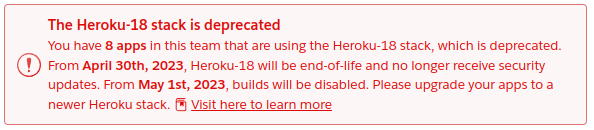
As of May 1st, 2023, Heroku will no longer be supporting the Heroku-18 stack. The reason for this deprecation is to maintain synchronization with the Ubuntu Long Term Support releases. If you are currently running your Rails application on this stack, when you navigate to the Heroku dashboard you will notice a warning to upgrade to either Heroku-20 or Heroku-22 before the end of the Heroku-18 stack life on April 30th, 2023.

Heroku warning: the Heroku-18 stack is deprecated

While Heroku-18 will not be supported, do not be alarmed or concerned that the apps running on this stack will stop working. Heroku has confirmed that all existing applications will not be interrupted and non-build functionality will still be available. However, to maintain access to security updates, technical support and the ability to perform new builds, an upgrade will be necessary and is highly recommended.

Read more opens a new window
Get the book