Articles by Ernesto Tagwerker

Follow @etagwerker on Github

How to Choose A Gem Wisely (To Prevent a Maintenance Nightmare)

Imagine this scenario: a developer added a pub/sub gem built on top of Sidekiq to handle background event broadcasting in your company’s Rails app. At the time, it was a huge win: instead of building a custom job orchestration system, they could drop in the gem, wire up a few events, and ship a feature in days instead of weeks.

Fast forward a few years: Sidekiq needed an update. You find out the gem wasn’t actively maintained anymore. But by then, the entire application depended on it. Core features like sending notifications, syncing with third-party APIs, and triggering billing logic all ran through this pub/sub layer.

Now you face a painful choice: either keep running on an unmaintained gem and risk breakage every time Sidekiq or Rails is updated, or rip it out and refactor the app to use a supported approach.

What began as a new dependency to save time has turned into a critical piece of fragile infrastructure. The lack of maintenance has turned what should have been a simple dependency update into a full-blown project.

How do we avoid getting into this situation in the first place? In this post, we’ll show you by digging into five critical areas to check before you choose a new gem.

Read more

Our Rails Upgrade Methodology as Claude Code Skills

For more than 8 years, we have been publishing detailed guides on how to upgrade Rails applications.

We have documented every minor version from Rails 2.3 through 8.1 in our Rails Upgrade Series and distilled our methodology into an ebook: The Complete Guide to Upgrade Rails

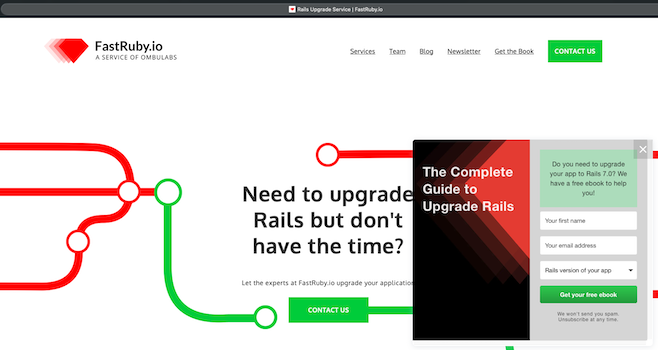
Our free e-book to upgrade rails is available on the FastRuby.io homepage

All of that knowledge comes from more than 60,000 developer-hours of hands-on upgrade work for companies of all sizes, from solo-founded SaaS products to huge Rails monoliths running at Fortune 500 public companies.

Today, we are making that methodology available to everyone as an open source Claude Code Skill opens a new window : claude-code_rails-upgrade-skill opens a new window .

Read more

Why Reliable Monthly Maintenance Became Non-Negotiable for a Solo SaaS Founder

For the past twenty years, TitleLeaf opens a new window has been helping educational book publishers maintain and share their content with industry partners such as reviewers, wholesalers, and distributors. Its robust content management system and handcrafted digital solutions simplify the process of sharing metadata, digital assets, and marketing material for the book industry.

Here was the situation

Tim Peterson, Founder of TitleLeaf, is a solopreneur balancing the challenges of entrepreneurship with a flexible lifestyle. One of his dreams is to have more time and freedom to do what he enjoys most—skiing and biking in the mountains of Northern California while still running his company as efficiently as possible.

Peterson’s goal is to build an ever-evolving, feature-rich SaaS service and share his domain knowledge with customers without having to manage a team or chase technical updates:

“I got fed up chasing contractors and micromanaging. I tried hiring and outsourcing, but nothing was the right fit. I just wanted reliable maintenance so I didn’t have to worry about it.”

Read more

Time to Migrate from Heroku

Today is a sad day because last week a platform that we know, like, and trust made a surprising and disappointing announcement.

On February 6, 2026, Heroku published an update on the future of the platform opens a new window . The announcement confirms what many in the community had suspected for a while: Heroku is transitioning to a “sustaining engineering model.”

In plain English, that means maintenance model: No new features, no new Enterprise Account contracts for new customers, and a focus on stability only.

If your Rails application runs on Heroku, this is the moment to start thinking about your next move. The platform is not disappearing overnight, but the direction is clear: Heroku’s best days are behind it and it’s time to migrate on your own terms to a provider that is not on maintenance mode.

Considering all this we are announcing a new productized service by FastRuby.io: Our Heroku Migration Service.

Read more

DIY Ruby on Rails Upgrades: Essential Open Source Tools

At FastRuby.io, we deeply value the Ruby and Rails communities and believe in giving back through open source contributions. We wouldn’t be where we are today if it wasn’t thanks to a lot of open source projects we use on a daily basis.

We actively use, maintain, and enhance several tools designed to empower developers and teams who want to handle Ruby and Rails upgrades themselves, especially those who might not have the budget to hire our services.

These open source projects facilitate upgrades by improving transparency, managing technical debt, and ensuring smooth transitions between Ruby and Rails versions.

Here’s an overview of each tool and how it can support your next upgrade project.

Read more

Valid Eval Achieves 2-5x Performance Gains, Improves Security for Ruby on Rails Architecture

Founded in 2011, Valid Eval opens a new window provides a secure, SaaS-based platform that helps organizations make defensible, data-driven decisions in high-stakes situations involving many applicants, subjects, domain experts, and judges. The Denver, Colorado-based company primarily serves federal government agencies that need to evaluate complex bids before awarding contracts.

Read more

ReadyTech Accelerates Revenue Growth, Cuts Infrastructure Costs 5-10% with Ruby on Rails Upgrade

Based in Sydney, Australia, ReadyTech opens a new window combines technology with a people-centric approach to help organisations navigate complexity and deliver meaningful outcomes. With more than 500 employees globally, the publicly-traded company continues to grow rapidly and now serves 4,000+ customers across three vertical segments: Education & Work Pathways, Workforce Solutions, and Government & Justice.

Read more

How and Why to Measure Dependency Freshness in your Ruby Application

Whether you are working in a legacy Ruby application, or a brand new application, measuring your dependency freshness score can be a positive indicator to understand whether you are staying current or gradually falling out of date.

Dependency freshness is defined as the difference between the currently used version of a dependency and the version that the system would ideally use.

In this article, I will discuss a couple of ways to keep track of how outdated or how fresh your dependencies really are.

Read more

Fortify Rails - Defending Your Ruby on Rails Applications from Bad Actors

On Monday June 12th, 2023, FastRuby.io partnered with Expedited Security opens a new window to talk about how to secure your Ruby on Rails application.

In this free webinar Ernesto Tagwerker opens a new window (FastRuby.io) and Mike Buckbee opens a new window (Expedited Security) discussed topics of interest related to Rails security (exploitable ActiveRecord code, vulnerable dependencies, botnets, DDoS, a breakdown of common threats, and more).

You’ll also get a sneak peak of Wafris opens a new window , an Open Source service to prevent attackers and dark traffic to your application and of our new Rails Security Audit, a service to detect vulnerabilities and exploitable code in your app!

Read more

Bonsai - Fixed-cost, Monthly Maintenance Service

Ever since we started offering productized Ruby and Rails upgrade services and upgrade roadmaps, we’ve been interested in helping as many people and companies as possible.

Unfortunately, in the past we’ve had to turn down companies who wanted to work with us but couldn’t secure the minimum monthly budget to work with our experts.

I’m pleased to announce that we’re now offering new opportunities for startups and small businesses to work alongside our team.

In this article, I will share a few new options to collaborate with our team of experts who specialize in technical debt remediation.

Read more

Power Home Remodeling Increases Server Speed by 40% with FastRuby.io's Tune Report

Power Home Remodeling (Power) opens a new window is the nation’s largest full-service exterior home remodeler and a top workplace.

Headquartered in Chester, Pennsylvania with offices in 18 territories across the United States, the award-winning company’s primary product line includes windows, siding, doors, roofing, solar roofing panels, and attic insulation.

In this article we will share how our Tune Report helped Power speed up their application by reducing their average page load time from 5 to 3 seconds.

Read more

4 Essential Security Tools To Level Up Your Rails Security

At FastRuby.io we love Ruby on Rails opens a new window because it is so powerful: You can quickly create an application that is feature complete, stable, and secure opens a new window

Unfortunately, maintaining a Rails application up to date and secure takes some effort.

In this blog post, we will cover a few Ruby gems and best practices that you can use to stay on top of your security, reliability, and stability needs.

Read more

How to Upgrade Rails Without a Test Suite

Sometimes you will be caught between a rock and a hard place. For example: You really need to upgrade your Rails application because Heroku is discontinuing your stack in two weeks so you don’t have the time to write an entire test suite.

Sometimes the situation will be that your boss really needs you to upgrade Ruby or Rails to use a version that gets security updates and they won’t allow you to write tests beforehand.

This article will explain how to ship a Rails upgrade project without a test suite. If your application has no tests, you will learn how to upgrade without having to write tests first.

Read more

How We Estimate The Size of a Rails Application

When inheriting a project or starting an upgrade, it is useful to understand how big and complex the application really is. So, what is a good way to understand whether a Rails application is tiny, medium, or huge?

The good news is that there are a couple of gems that make this easy for us.

In this article I will explain how you can use these gems to begin to understand the size and complexity of a Rails application.

Read more

What are the Code Coverage Metrics for Ruby on Rails?

At FastRuby.io we are constantly looking at code coverage metrics for Ruby on Rails applications. It’s a key indicator for us. We even use that information to decide whether we work on a Rails upgrade project or not.

So, I was interested in seeing code coverage metrics for the Ruby on Rails framework opens a new window . I couldn’t find any information about this online, so I decided to generate a few reports for each component.

This is an article about my process and my findings.

Read more

Churn vs. Complexity vs. Code Coverage

Churn vs. Complexity analysis is a great way to find insights about the maintainability of a project. Two of my favorite authors have written great articles about the Churn vs. Complexity graph:

This two-dimensional graph can be very useful in finding the files that are the hardest to maintain in your application. In this article I will explain:

  1. How you can calculate these metrics and use them in your legacy project
  2. How code coverage metrics can guide your technical debt’s collection efforts
Read more

Our Guide for Unmaintained Open Source Projects

There are some really great guides for starting a new open source projects opens a new window , yet when it comes to dealing with a possibly abandoned, unmaintained project, there is no definitive guide for users, contributors, or maintainers.

I hope that this can be a useful guide for our community.

Problem

When do you declare that an open source project has been abandoned? How many days have to go by until you start maintaining your own fork? What’s the standard for communicating with maintainers, contributors, and users? How do you avoid n competing OSS forks of popular projects? How do you avoid duplicated work by people who want to maintain popular, but unmaintained OSS projects? What’s the best way to find that one fork everybody is using?

Read more

How to Calculate Tech Debt Using Skunk on GitHub Actions

Right before my talk at RubyConf Australia opens a new window , I worked on a way to make it easy for anyone to run skunk in their Ruby projects. In order to do that I decided to use GitHub Actions opens a new window . It’s a powerful service by GitHub and it’s quite easy to set up.

This article is about the process that I followed and how you can use it in your own application.

Read more

Escaping The Tar Pit: Introducing Skunk v0.3.2 at RubyConf 2019

This year I had the honor to speak at RubyConf opens a new window in Nashville. It was my second time attending the conference and first time as a speaker. I talked about skunk, a gem to calculate the SkunkScore opens a new window of a module or set of modules.

Since its inception, skunk has changed quite a bit based on real usage in our productized service for Rails upgrades. As a matter of fact, the night before my talk I realized there was a BIG error in our formula.

Here is a description of the problem and solution.

Read more

Introducing Skunk: Combine Code Quality and Coverage to Calculate Your Project's SkunkScore

Two weeks ago I had the opportunity to speak at Solidus Conf 2019 opens a new window . I presented Escaping the Tar Pit opens a new window for the first time and I got to talk about a few metrics that we can use to quickly assess code quality in any Ruby project.

In this article I’d like to talk about Skunk: A SkunkScore Calculator opens a new window ! I’ll explain why we need it, how it works, and the roadmap for this new tool.

Read more

RubyCritic v4.2.0: Now with SimpleCov Support

Every time we evaluate a new project we follow a well-defined process to decide whether we take it or not. We analyze its dependencies; its code coverage; and its code quality to determine the amount of tech debt in a project. We have been using CodeClimate opens a new window to assess code quality and SimpleCov opens a new window to assess code coverage.

In my previous article I wrote about free and open source Ruby gems we can use to assess code quality for any Ruby or Rails project. After writing that article, I found that RubyCritic opens a new window was really interesting and its community quite active, so I thought it was a good idea to add SimpleCov support to it: https://github.com/whitesmith/rubycritic/pull/319 opens a new window

Read more

Three Awesome Libraries to Assess Code Quality in Ruby

As part of our Rails upgrade business we get to evaluate a lot of codebases every month. We usually need a quick way to assess the quality of the code we get. For this we like to use CodeClimate opens a new window and SimpleCov opens a new window .

CodeClimate is free for open source projects and paid for private projects. I know that not everybody can pay for their service, so I thought it was a good idea to share some free, open source alternatives.

Here is a list of 3 tools that can help you assess the quality of your next codebase.

Read more

How to Upgrade Any Rails Application Using Docker

Every time we start a new Rails upgrade project, we need to setup a whole new environment in our local machines. Sometimes that leads us down the rabbit hole which ends up breaking our environment for other client projects.

After years upgrading Rails applications, we learned that the best way to isolate our client projects’ environments is using Docker opens a new window .

That’s why we decided to use Docker and docker-compose opens a new window for all of our client projects. This year I had the opportunity to share our process in a series of workshops: Upgrade Rails 101: The Roadmap to Smooth Upgrades opens a new window

Read more

Upgrade Rails 101: The Roadmap to Smooth Upgrades

This year’s RailsConf opens a new window was a special conference for me. It was my third time attending and my first time speaking at the conference. I conducted a 2-hour workshop for anyone interested in upgrading their Rails application: Upgrade Rails 101: The Roadmap to Smooth Upgrades opens a new window

Here are a few lessons learned from running such an ambitious workshop.

Read more

How to Dual Boot Rails

In this article I will explain how you can dual boot your application in your local environment and your continuous integration (CI) service. I hope that this will help you get ready for the next stable release of Rails.

Read more

Legacy Rails: Silently Judging You

I had to come up with a clever title because this article is about legacy Rails opens a new window applications and I know that you might fall asleep by the third paragraph. Boooooring… You probably want to read about that new JavaScript framework that came out (I love that this sentence will always be true, it doesn’t matter when you read this)

If you have been working with Rails for a few years, you have seen your fair share of shiny new applications, well-maintained and poorly-maintained legacy applications. This post is about Legacy Rails applications

Read more

Three Useful Data Migration Patterns for Rails

At OmbuLabs opens a new window , we are big fans of Ruby on Rails opens a new window and design patterns opens a new window , especially convention over configuration opens a new window ! The beauty of Rails is that you can inherit a legacy project and easily find the different layers of code in different directories.

When it comes to database migrations the policy of Rails is very clear. It’s all about altering the database structure with gradual migration files: “Migrations are a convenient way to alter your database schema over time in a consistent and easy way.” (source opens a new window )

But, what about data migrations? What’s the best way to write, maintain, and run migrations that alter the data in your production database?

In this article I will talk about three different patterns for writing and maintaining your data migrations:

  1. Data migrations in db/migrate
  2. Data migrations with a set of Rake tasks
  3. Data migrations with data_migrate
Read more

Notes from The Complete Guide to Rails Performance's Workshop

If you are interested in Ruby and Rails performance, you have definitely read articles by Nate Berkopec opens a new window from Speedshop opens a new window . At Ombu Labs we are big fans of his work, his Complete Guide to Rails Performance book opens a new window and Slack community.

When Nate announced a series of public workshops opens a new window I didn’t hesitate and signed up as quickly as possible. Here are my notes from my experience at the workshop on October 17th.

Read more

Tips for Writing Fast Rails: Part 1

Rails opens a new window is a powerful framework. You can write a lot of features in a short period of time. In the process you can easily write code that performs poorly.

At OmbuLabs opens a new window we like to maintain Ruby on Rails applications opens a new window . In the process of maintaining them, adding features and fixing bugs, we like to improve the code and its performance (because we are good boy scouts opens a new window !)

Here are some tips based on our experience.

Prefer where instead of select

When you are performing a lot of calculations, you should load as little as possible into memory. Always prefer a SQL query vs. an object’s method call.

Read more
Get the book